
What Is AI Identity Infrastructure? Identity for Agents, Models, and Tools
AI agents need more than API keys. This article maps the identity, delegation, policy, audit, and trust components used to control agents, models, tools, and data.
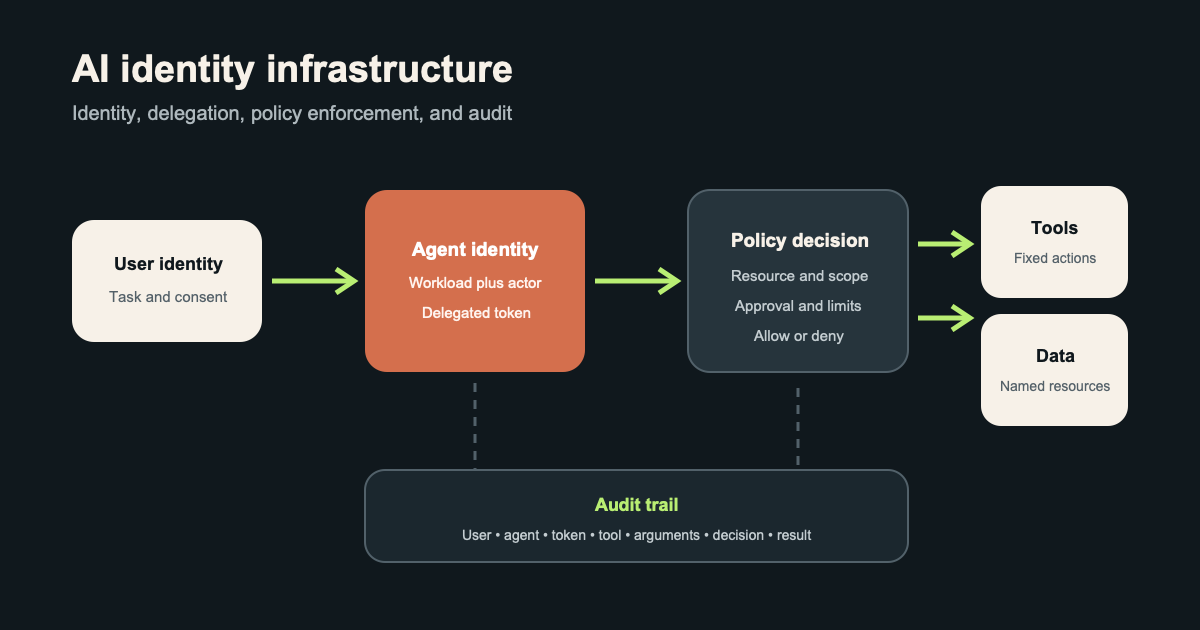
AI identity infrastructure is an emerging umbrella term for the systems that identify AI agents and related workloads, authenticate them, represent delegated authority, enforce access policy, record their actions, and remove access when authority ends. It also connects agent activity to the human, organization, or service that initiated it. The term does not name one settled standard or product category.
NIST launched its AI Agent Standards Initiative in 2026 and described research into agent authentication and identity infrastructure. Its related NCCoE concept paper asks open questions about agent identification, credentials, delegation, least privilege, audit, and prompt injection.
The phrase describes an architectural synthesis. Existing identity standards provide many components, while agent-specific profiles and delegation models are still under development. An implementation should state which published standards it uses and which behavior is local policy.
Key Takeaways
- Treat the user, agent runtime, model service, tool server, and data service as distinct entities with separate trust decisions.
- Bind delegated authority to an authenticated agent or workload identity, a target resource, permitted actions, and a limited lifetime.
- Enforce policy again at every tool and data boundary instead of trusting an agent plan or model output as authorization.
- Preserve the delegation chain, policy decision, approval, tool call, result, and revocation state in an audit record.
AI Identity Infrastructure Is an Emerging Architecture
No published NIST or IETF standard defines AI identity infrastructure as one complete stack. The NIST concept paper is a proposal for further work, not a finished control framework. Several IETF agent identity and delegation documents are Internet-Drafts, which the IETF labels as work in progress rather than standards.
Published foundations still apply. OAuth defines authorization patterns, SPIFFE defines workload identity, and zero trust guidance treats identity as an input to access decisions. Agent systems add model provenance, tool mediation, memory controls, approval, and audit.
The umbrella term covers several control planes
Identity infrastructure answers who or what is making a request. Delegation records whose authority supports that request. Authorization decides whether the action is permitted for the target resource under current conditions.
Principals, Agents, Models, and Tools Need Separate Identities
A principal is an entity whose identity or authority matters to a security decision. In an agent workflow, the principal may be a user, an organization, a service, or another workload. The agent may act for that principal, but it should not silently become the same identity.
An agent runtime is software executing a task. It may qualify as a non-human identity and a workload identity. A stable agent definition may create many short-lived instances, so the system may need identifiers for the configured agent and the individual run.
A model identifier is not automatically a security principal
A model can have a provider, name, version, digest, deployment endpoint, and evaluation record. Those identifiers support provenance and policy, such as allowing a reviewed model version to process one data class. They do not prove that the model itself holds a credential or can authenticate to a resource.
In many systems, the model runs behind a service and the service identity makes network requests. Security records should preserve the model version and authenticated workload without treating them as the same entity.
Tool identity defines the enforcement destination
A tool may be a local function, an HTTP API, an MCP server, a database operation, or another agent. Each boundary needs a stable resource identifier and an authority that can evaluate access. A tool name shown to the model is not sufficient because names can collide and descriptions can come from an untrusted source.
The resource should authenticate its caller and enforce its own policy. An orchestrator can deny a call early, but the downstream service remains responsible for its data and operations.
Credentials Should Bind Identity to a Trust Domain
Credentials let an entity prove an identity claim. Agent systems may use certificates, signed workload documents, OAuth client authentication, access tokens, or cloud-native credentials. Long-lived shared secrets make it hard to distinguish instances or end access promptly.
The SPIFFE specifications provide one workload identity model. A SPIFFE ID names a workload inside a trust domain, and a verifiable identity document proves that identity under the domain’s authority. Federation supports validation across trust domains under an explicit relationship.
Trust domains limit what an identity claim means
An authenticated name has meaning only under an issuer and verification policy. Two organizations can use the same agent label without referring to the same workload. Trust domains, token issuers, audiences, and certificate roots limit where a claim is accepted.
Cross-domain use requires an explicit trust decision. A verifier should know which issuer it trusts, which claims it accepts, and whether the identity may act on the requested resource. Federation authenticates an external identity, but authorization policy still decides what that identity can do.
Delegation Connects Agent Authority to a Principal
Delegation lets an agent exercise a limited part of another principal’s authority. A delegation record identifies the delegator, actor, target, action, conditions, time limit, and whether further delegation is allowed. Logs and tokens should distinguish delegation from impersonation.
OAuth 2.0 Token Exchange, RFC 8693, defines a published protocol for exchanging security tokens and supports delegation and impersonation semantics. It includes subject and actor concepts, but it does not define a complete trust model for AI agents. Agent-specific delegation chains remain an area of active draft work.
Delegated tokens should lose authority, not gain it
A token created for a subtask should have a narrower resource, scope, lifetime, or set of conditions than its parent authority. RFC 8707 lets an OAuth client identify the protected resource where it intends to use a token. Audience restriction limits reuse at another service.
Scopes and structured authorization details can express permitted access, but neither decides business policy automatically. Authorization and resource servers must interpret the request under local rules.
Policy Enforcement Must Surround Every Tool Action
The model may propose a plan, choose a tool, and construct arguments. None of those outputs should count as authorization. A policy enforcement point should evaluate the authenticated actor, delegated principal, resource, requested action, data sensitivity, task state, and environmental conditions.
NIST SP 800-207A describes identity-based access control for applications and services in multi-cloud environments. Its model is not agent-specific, but its separation of identities, policy decision points, and policy enforcement points fits agent tool access. The resource should make or receive an enforceable decision for each protected operation.
Approval should attach to the exact action
Human approval can control a payment, destructive change, disclosure, or privilege increase. The approval record should show the resource, action, important parameters, requesting agent, represented principal, and expiration. A generic approval to “continue” leaves too much room for the plan to change afterward.
If the target or parameters change after approval, policy should require another decision. The stored authorization should bind to machine-readable action details.
Memory and Data Access Need Their Own Authorization Context
Agent memory may contain user preferences, task history, retrieved documents, secrets, or summaries created from protected data. Access to the memory store should follow the same identity and authorization rules as access to any other service. The model’s context window is a data destination, not an exception to policy.
Data retrieved under one user’s authority should not appear in another user’s run because both use the same agent definition. Partitioning, retention, and deletion rules need to follow the relevant principal and purpose.
Aggregated data can cross a policy boundary
The NIST concept paper raises the problem of an agent gaining access to several tools and aggregating data of different sensitivity. Individual reads may be permitted while the combined output is not. Policy therefore needs to consider the destination, requested transformation, and disclosure audience in addition to source permissions.
This is also where prompt injection can become an identity problem. Untrusted content may influence an agent to request a legitimate tool under valid credentials. Authorization limits the available action even when the model’s instruction handling fails.
Audit Trails Must Preserve Identity, Authority, and Outcome
An agent audit event should connect the initiating principal, agent instance, token identifier, delegation, policy version, tool, action, approval, result, and timestamp. Correlation identifiers should link authorization, execution, and downstream calls. Sensitive arguments can be hashed or stored under restricted access.
The NIST AI RMF calls for documented roles, system scope, human oversight, third-party components, and production monitoring. It does not prescribe an agent audit schema. Its governance outcomes support keeping enough evidence to reconstruct which actor and control produced an action.
Audit needs decision records as well as model text
A transcript shows what the model said, but it may omit token exchange, policy evaluation, retries, background jobs, and direct service calls. Infrastructure logs should record the security decision independently of the natural-language trace. Otherwise, a fluent explanation can obscure the authority used at execution time.
Denied tool calls, expired grants, invalid audiences, approval rejection, and revocation attempts help teams test policy and investigate abuse.
Revocation Must Reach Tokens, Tasks, and Stored Authority
Ending an agent session should stop new work and remove any authority created for that session. Short token lifetimes reduce exposure, but they do not replace explicit revocation for long-running tasks or compromised credentials. OAuth Token Revocation, RFC 7009, defines a way for clients to request token invalidation.
Agent infrastructure may also need to cancel queued calls, revoke refresh tokens, terminate subtasks, rotate credentials, and clear cached decisions. Scheduled actions need review because they can outlive the interactive session. Revocation is complete when each enforcement point rejects the old authority.
Trust Boundaries Define the AI Identity Architecture
Map boundaries between the user interface, orchestrator, model provider, memory store, tool server, authorization server, and target service. For each crossing, record the identity, issuer, audience, delegated principal, policy authority, and audit destination. This reveals shared secrets, forwarded tokens, and unverified claims.
The OWASP Top 10 for Agentic Applications includes tool misuse and identity and privilege abuse. An architecture cannot prevent every unsafe model choice, but it can restrict the credentials, resources, and actions available after one. That is the practical purpose of AI identity infrastructure.
Readers who need the surrounding terms can continue with the least privilege, zero trust, and AI security glossary entries.
Frequently Asked Questions
Is AI identity infrastructure a standard?
No published standard defines AI identity infrastructure as one complete system. NIST is studying agent identity and authorization, while several IETF proposals remain Internet-Drafts. Implementations can use published identity and authorization standards without claiming that the umbrella architecture is standardized.
Does an AI model need its own identity?
A model needs a stable identifier, version, provider, and provenance record for many policy and audit uses. The authenticated principal is often the service or workload that hosts or invokes the model. Treat a model as a principal only when the architecture gives it credentials and a defined authority boundary.
How should an agent act for a user?
The agent should authenticate as its own client or workload and present authority delegated by the user. The grant should limit resource, action, conditions, and lifetime. Logs should preserve both the user and agent instead of recording the action as if the user performed it directly.
What should happen when agent access is revoked?
The system should invalidate relevant tokens and stop new protected actions. It should also cancel delegated tasks, clear cached decisions, and review scheduled work or memory access created under the grant. Audit records should show when revocation reached each enforcement point.
AI Identity Infrastructure Makes Agent Authority Inspectable
AI identity infrastructure is useful as an architectural label, provided it is not presented as a finished standard. It brings workload identity, user delegation, resource-bound credentials, policy enforcement, data controls, audit, and revocation into one model.
A reviewer should be able to determine which principal initiated a task, which agent executed it, which credentials crossed each boundary, why a tool allowed the action, and how access ends. That evidence matters even when the model changes its plan.