What Is Non-Human Identity Security? Discovery, Ownership, Credentials, and Access
A practical guide to finding non-human identities, assigning owners, reducing credential risk, and controlling access across their lifecycle.
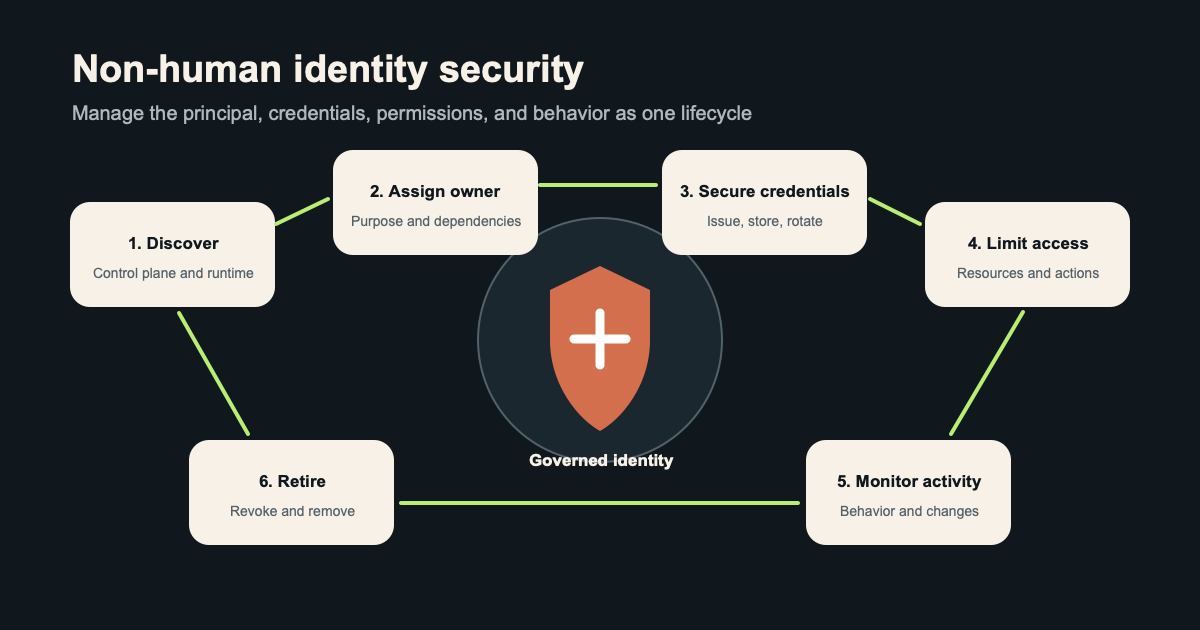
Non-human identity security is the practice of finding, governing, and monitoring digital identities used by software, devices, workloads, and automated processes. It covers the identity object, every credential that can authenticate as it, the permissions it receives, and the systems that create or depend on it.
That scope matters because a service account is not the same thing as its password, API key, certificate, or token. An organization can rotate a secret and still leave the account overprivileged, ownerless, or active after its application has been retired.
Key Takeaways
- Treat each non-human identity as a principal with an owner, purpose, environment, permissions, credentials, and retirement condition.
- Discover identities from control planes and runtime activity because configuration records alone miss embedded secrets, local accounts, and unused objects.
- Prefer narrowly scoped, short-lived credentials issued after workload verification, while retaining a tested path to revoke access quickly.
- Monitor identity behavior as well as credential age, including interactive use, new source systems, unusual APIs, and privilege changes.
How Non-Human Identities Differ from Human Identities
Human identity programs usually begin with a person whose employment or customer relationship supplies a name, manager, status, and lifecycle event. Non-human identities begin with a technical purpose such as running a deployment, calling an API, signing code, reading a queue, or authenticating a device.
NIST Special Publication 800-63-4 addresses digital identity for people and explicitly leaves machine-to-machine authentication, interconnected devices, and API access on behalf of subjects outside its scope. That boundary explains why simply placing service accounts in a human identity process leaves important questions unanswered.
A person can complete identity proofing and respond to an authentication challenge. A workload instead proves facts about its execution context, presents a provisioned credential, or receives a token through a trusted platform. Its lifecycle may last for seconds, years, or anything between those points.
Non-human identities also operate without a person deciding to sign in each time. They may authenticate continuously across production systems, so a dormant owner record or a broad role can create persistent access with little visible friction.
Common Types of Non-Human Identities
The category includes service accounts in directories and cloud platforms, application registrations, OAuth clients, Kubernetes ServiceAccounts, device identities, CI/CD runners, integration users, database accounts, certificates assigned to systems, bots, and automation jobs. Some are durable administrative objects, while others are created for one workload instance and disappear with it.
Kubernetes documentation gives a precise example. It describes a ServiceAccount as a non-human account that supplies a distinct cluster identity for workloads and automation, separate from user accounts intended for people.
A workload identity is a narrower concept. It identifies a software workload, often through claims about where and how that workload is running. A non-human identity can also represent a device, an application object, a shared integration account, or an automated agent.
Separate the identity from its credentials
An identity is the principal to which policy and activity are attached. A credential is evidence used to authenticate as that principal, such as a client secret, private key, API key, signed assertion, or access token.
One identity may have several active credentials during rotation or migration. One leaked credential may also be copied into several repositories and runtime environments, which creates multiple exposure points without creating new identities.
This distinction changes inventory design. The identity record should show ownership, purpose, access, and lifecycle status, while linked credential records show type, location, issuer, creation date, expiry, and last rotation.
Discover Non-Human Identities Across Systems
Discovery should start with systems that issue identities or accept them. Cloud IAM services, enterprise directories, Kubernetes clusters, SaaS administration consoles, certificate authorities, secrets managers, CI/CD platforms, source repositories, and database catalogs each reveal a different part of the population.
Control-plane enumeration finds registered objects, role bindings, certificate records, and known secrets. Runtime logs find identities that are still authenticating, including accounts whose original configuration owner no longer recognizes them. Code and image scanning can find hard-coded credentials that never entered a managed secret store.
No single scan produces a trustworthy inventory. Records need correlation by stable identifiers, credential fingerprints, issuer data, workload metadata, and observed destinations so the same principal is not counted as unrelated objects in every tool.
An inventory is useful only if it answers operational questions. For each identity, record the responsible team, business or system purpose, environment, provisioning method, credential locations, effective permissions, dependencies, last use, expected behavior, expiry, and retirement trigger.
Assign accountable owners and technical custodians
Ownership should point to a maintained team or service catalog entry, not solely to an employee who may change roles. The accountable owner approves purpose and access, while a technical custodian maintains deployment, rotation, and incident response.
Shared infrastructure identities may need a platform owner and several consuming teams. In that case, document who can change the identity, who can request permissions, and who receives an alert when its behavior changes.
An identity without a confirmed owner should enter a defined review path. Disabling it without dependency evidence may cause an outage, but leaving it active indefinitely preserves unknown access. Last-use data, dependency tracing, staged permission removal, and rollback planning make retirement safer.
Manage the Non-Human Identity Lifecycle
The lifecycle begins before credential issuance. A request should name the workload or process, its owner, target resources, required actions, environment, expected lifetime, and provisioning path. Approval should produce a distinct identity wherever the platform supports one, rather than extending a shared account.
Provisioning should be automated so identity creation, policy attachment, credential delivery, and inventory registration happen together. Manual steps often create a valid account but omit its owner, expiry, or secret location.
During use, access reviews should compare granted permissions with observed actions and the current application design. Rotation replaces credential material, but it does not correct obsolete roles, duplicate accounts, or cross-environment reuse.
Retirement must remove policy bindings, revoke active credentials and sessions, disable the principal, and update dependent systems. The OWASP Non-Human Identities Top 10 for 2025 places improper offboarding first and separately identifies secret leakage, long-lived secrets, reuse, and weak environment isolation.
Use short-lived credentials where the platform supports them
Short-lived credentials reduce the time that copied material remains useful. They work best when a trusted issuer verifies the workload before issuing them and when the receiving service validates issuer, audience, subject, and expiry.
SPIFFE defines a workload identity model in which an SVID carries a SPIFFE ID as an X.509 certificate or JWT. Its Workload API can stream updated identity documents to workloads, which supports automatic rotation without placing a durable shared secret in application configuration.
Short lifetime is not instant revocation. A credential may remain accepted until expiry unless the architecture includes revocation or policy enforcement that can block the identity sooner. Incident plans should state how to disable issuance, reject an identity, and remove its authorization.
Limit Permissions and Credential Exposure
Apply least privilege to the identity, not just its nominal role name. Effective access can include direct grants, nested groups, inherited cloud policies, resource policies, delegated roles, and permissions gained through another service.
Scope access to the required resources, actions, environment, and time window. Separate production from development identities, and avoid a shared integration account whose credential permits several unrelated applications to act under one audit trail.
Credential controls should match the authentication method. Store reusable secrets in a managed secrets service, restrict retrieval, prevent them from entering source code or logs, and rotate them through an automated process. For certificate or private-key authentication, protect the private key and define issuance, renewal, trust-store update, and revocation procedures.
NIST SP 800-207A says cloud-native access policies need application and service identities in addition to user identities and network parameters. Network location alone does not establish which workload is making a request or whether that workload should receive the requested action.
Monitor Non-Human Identity Activity
Monitoring should compare current behavior with the identity’s documented purpose. Useful signals include authentication from a new host or cluster, interactive login by a service account, use outside a deployment window, access to an unfamiliar API, failed calls after a policy change, privilege escalation, and concurrent use from unrelated environments.
MITRE ATT&CK Valid Accounts includes service account anomalies, interactive or remote service-account logins, and container identities used from unexpected nodes or IP addresses in its detection guidance. These signals need identity context because the same network event can be ordinary for one automation job and suspicious for another.
CISA’s visibility and hardening guidance also recommends monitoring service-account logins, disabling inactive accounts, and centralizing logs.
Logs should preserve the stable identity, credential or session identifier where available, source workload, issuer, requested resource, decision, and policy that allowed or denied the action. Central collection helps connect credential issuance with later API activity and privilege changes.
Response procedures should support disabling the principal, revoking sessions or tokens, rotating exposed material, removing access bindings, and identifying every dependent workload. Rotating a secret without blocking the identity can leave an attacker active through another token or credential.
Common Non-Human Identity Failure Modes
Several failures recur because identity, credential, and permission data are managed separately. A secret scanner may report leaked material without showing its effective access, while an IAM review may show an account but miss where its secret was copied.
| Failure | What happens | Control response |
|---|---|---|
| Ownerless identity | Reviews stall and retirement is delayed | Require a team owner and escalation path |
| Shared identity | Several workloads produce one audit trail | Issue a distinct identity per workload and environment |
| Long-lived secret | Copied material remains useful for months or years | Use automated rotation or identity-based issuance |
| Excess permissions | A narrow process can reach unrelated resources | Compare effective grants with observed required actions |
| Incomplete offboarding | Credentials or role bindings survive application retirement | Revoke sessions, credentials, bindings, and the principal |
| Human use of service accounts | Accountability and human controls are bypassed | Block interactive use and provide named emergency access |
The controls should be measured by outcomes. Coverage metrics can include identities with verified owners, credentials with known locations, access reviewed against use, short-lived issuance adoption, stale identities retired, and time required to contain a compromised principal.
Frequently Asked Questions
Is a service account always a non-human identity?
A service account is generally created for a workload or automated process, so it normally falls within non-human identity management. Some environments allow people to sign in with service accounts, but that is a misuse pattern rather than a different identity class. Block routine interactive access and provide named, auditable human accounts instead.
Is an API key a non-human identity?
An API key is usually a credential, not the identity itself. The service accepting it may map the key to an application, account, project, or principal. Security records should preserve that mapping so ownership, access, and activity remain visible when the key rotates.
Does secret rotation solve non-human identity security?
Rotation limits how long one credential remains valid, but it does not remove excessive permissions or obsolete identity objects. It also cannot repair missing ownership, cross-environment reuse, or weak monitoring. Treat rotation as one lifecycle control within a broader identity program.
How often should non-human identities be reviewed?
Review frequency should reflect privilege, exposure, credential lifetime, and change rate. High-access production identities need continuous monitoring and review after material policy or ownership changes. Lower-risk identities still need scheduled confirmation that their purpose, owner, access, and dependencies remain current.
Build Controls Around the Whole Identity
Non-human identity security works when discovery, ownership, credential management, authorization, monitoring, and retirement describe the same principal. Keeping those records connected makes it possible to judge what an identity is, why it exists, what it can do, and how to stop it.
Start with identities that can change production, reach sensitive data, issue credentials, or cross trust boundaries. Confirm their owners and dependencies, then reduce shared access, shorten credential lifetime, review effective permissions, and test containment before expanding coverage.